Your vote
The bûche: chocolate or chestnut?
One tap. No email needed.
What is a bûche de Noël?
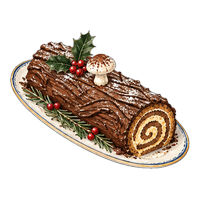
Bûche means log, and that is what it is meant to look like. A thin sheet of sponge cake is spread with cream and rolled up, then covered with more cream, which is dragged with a fork so that it looks like bark. One end is often cut off at an angle and stuck on the side as a sawn-off branch. There is usually a dusting of icing sugar for snow and, in a French home, at least one small plastic axe or elf that has been in the family longer than the children.
The cake recalls an older custom: a very large log, chosen for the purpose, that was lit in the hearth on Christmas Eve and expected to burn through the night. When hearths became rare, the log moved to the table.
The cake is Parisian. The pastry chef Pierre Lacam credited it to Antoine Charabot, of the Maison Quillet, in 1879. Within a few years it was the fashionable Christmas dessert in Paris, and Lacam published one of the first recipes in 1890: a sponge filled and covered with buttercream, textured like bark. Ganache came later.
Do French people make their own bûche?
Mostly, no. This is the part nobody tells you. In December every pâtisserie window in France is full of bûches, and choosing and ordering yours is its own small ritual. The frozen-food shops sell ice-cream versions, bûches glacées, by the million. A French host who serves a bought bûche is not cutting a corner. She is supporting her baker.
In Sacha’s family in Paris there was always a bûche at the end of the réveillon, the way there was always a tree. A homemade bûche is a lovely thing to do with children, it costs a fraction of the bakery price, and the plain chocolate one below is honestly not hard.
How do you roll the sponge without cracking it?
Roll it while it is still warm. That is the whole secret. A sponge that cools flat sets flat, and then breaks when you bend it. So as soon as it comes out of the oven, turn it out onto a clean tea towel dusted with sugar, peel off the baking paper, and roll it up in the towel from a short side. Let it cool in that shape.
When you unroll it to fill it, it will already know where it is going. Two other things help: do not overbake it, because a dry sponge cracks, and do not worry about a small split, because the whole cake is about to be covered in cream. The bûche is the most forgiving dessert in France. Bark is supposed to look rough.
What flavours of bûche are there?
Chocolate is the classic, and coffee and chestnut are the other two traditional ones. Chestnut cream, crème de marrons, is very French and very good with chocolate. The bakeries now compete with something new every year: praline, passion fruit, pear and caramel, yuzu. The ice-cream bûche has its own loyal following, especially after a dinner of oysters, foie gras and a roast bird, when something cold seems like wisdom.
The official test
Could You Survive a French Dinner Party?
When to arrive, what to bring, where to put your hands. Eight questions. I failed all of them in real life.
Take the quizWhen do you serve it?
At the very end of the réveillon, the long dinner on the evening of the 24th, after the cheese. By then it is late, and a slice is small: a finger’s width is normal. One bûche comfortably serves eight to ten people who have already eaten five courses.
It is brought to the table whole, so that everyone can see it before it is cut. If you made it yourself, this is your moment. Take it.
Make it or buy it
| Homemade | From the pâtisserie | |
|---|---|---|
| Time | About an hour of work, plus chilling | The length of the queue on the 24th |
| Cost | A fraction of the bakery price | It is the baker’s best month |
| Looks | Rustic. Bark is forgiving | Like a small sculpture |
| What the French do | For fun, often with children | Most of the time |
Questions, answered
What is a bûche de Noël?
The traditional French Christmas dessert: a sponge cake spread with cream, rolled up, covered in more cream and decorated to look like a log.
Why is the French Christmas cake shaped like a log?
It recalls the large log that was traditionally burned in the hearth through Christmas night. The cake version was created by Paris pastry chefs in the late nineteenth century; the first published recipe dates from 1890.
How do you stop a bûche de Noël from cracking?
Roll the sponge in a sugared tea towel while it is still warm and let it cool rolled up. Do not overbake it, as a dry sponge cracks.
Can you make a bûche de Noël ahead of time?
Yes. It is better made the day before and kept in the fridge, which makes it easier to slice. Dust it with icing sugar just before serving.
Do French people make or buy their bûche de Noël?
Most buy it from a pâtisserie or as a frozen ice-cream bûche. Making one at home is less common but not difficult.
Still wondering?
Ask my French husband.
A short ruling in a few seconds. Written by AI from our Journal, in his voice.
He judges America weekly on Instagram, and Le Bulletin collects the best of it.