Your vote
Thirteen desserts: tradition or too much?
One tap. No email needed.
What are the 13 desserts?
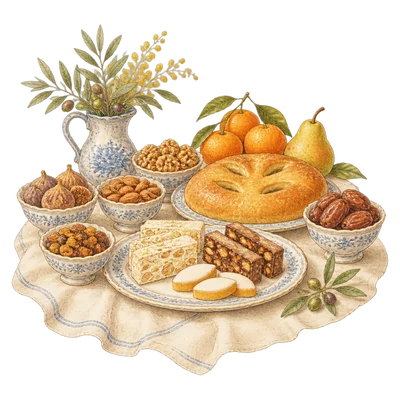
Les treize desserts are the end of Christmas Eve in Provence. After the gros souper, the “big supper” on the night of the 24th, thirteen sweet things go on the table at once: dried fruit and nuts, nougats, fresh fruit, small pastries and a sweet bread. It is less a dessert course than a landscape, and nobody is expected to finish it. Everyone is expected to taste each one.
The list
The number never changes. The list does, from town to town and family to family. A common version:
| Dessert | What it is |
|---|---|
| 1–4. The four mendiants | Raisins, walnuts or hazelnuts, dried figs and almonds, for the four orders of mendicant friars |
| 5. Dates | For the land where Christ was born |
| 6. White nougat | Soft, with honey, almonds and pistachios |
| 7. Black nougat | Hard, with honey and almonds |
| 8. Pompe à l’huile | A flat sweet bread made with olive oil and orange-flower water |
| 9. Calissons | Almond paste and candied melon, from Aix-en-Provence |
| 10. Quince paste | Pâte de coing, cut in squares |
| 11. Candied fruit | Often citron or clementines |
| 12–13. Fresh fruit | Usually oranges or clementines, and pears or a melon kept from the summer |
Other families swap in oreillettes (thin fried pastries), pain d’épices, biscuits from Allauch called casse-dents (“tooth-breakers”), or a fruit tart. Some count a bûche de Noël as the thirteenth.
This or that
How French Is Your Christmas?
Oysters or shrimp, the 24th or the 25th, a bûche or cookies for Santa.
Take the quizWhat do they mean?
Thirteen stands for Christ and the twelve apostles at the Last Supper. The four mendiants stand for the four mendicant orders, their colours matching the friars’ robes: raisins for the Dominicans, nuts for the Augustinians, figs for the Franciscans, almonds for the Carmelites. The two nougats are often read as good and evil, white and black. Tasting every dessert is said to bring luck for the year ahead.
When are they served?
On Christmas Eve, after the gros souper, a meatless meal of several courses, traditionally before midnight mass. The desserts then stay on the table for three days, until 27 December, so anyone who drops by can have some. For the rest of a French Christmas, see how the French celebrate Christmas and our French Christmas dinner menu.
How to do it at home
Most of the list is shopping, not baking. Dried figs, dates, raisins, walnuts and almonds are in every grocery store. Nougat, calissons and quince paste are in good cheese shops, in specialty grocers and online, especially in December; see where to buy French snacks in the US. Add clementines, a pear and something you make yourself. Set it all out at once, on your best plates, and leave it there for the next two days. Thirteen sounds like a lot until you count the nuts.
Questions, answered
What are the 13 desserts of Provence?
Thirteen sweets served on Christmas Eve in Provence: the four mendiants (raisins, nuts, figs, almonds), dates, white and black nougat, the pompe à l’huile, calissons, quince paste, candied and fresh fruit. The list varies by family.
Why are there 13 desserts?
For Christ and the twelve apostles at the Last Supper.
When are the 13 desserts eaten?
After the gros souper on Christmas Eve. They stay on the table until 27 December.
What are the four mendiants?
Raisins, walnuts or hazelnuts, dried figs and almonds, for the four mendicant orders.
What is a pompe à l’huile?
A flat, sweet Provençal bread made with olive oil and orange-flower water.
Sources
- Wikipedia, “Thirteen desserts”: symbolism, the four mendiants and their orders, the nougats, the pompe à l’huile, the table kept until 27 December. wikipedia.org
- The Good Life France, “Thirteen desserts of Provence at Christmas”. thegoodlifefrance.com
Verified November 2026.