Your vote
A little help with the wrinkles?
One tap. No email needed.
The short answer
Yes. French women get Botox, and filler, and lasers, and everything else. Anyone claiming a nation of women reaches fifty on moisturiser alone is selling something. But the conclusion people jump to next — that the “French natural look” is a cover story for a lot of quiet work — is also not supported by anything. The truthful position is narrower and less satisfying: the practice exists, the disclosure does not, and the data to settle the argument has never been collected.
What the numbers actually show
ISAPS, the international body that surveys board-certified plastic surgeons, counted 37.9 million procedures worldwide in 2024. The United States led by a distance: over six million procedures, more than four million of them non-surgical. Brazil was second at 3.1 million, Japan third at 1.6 million. France does not appear in that leading group at all. That is not proof of restraint — the survey counts procedures by board-certified plastic surgeons, and a great deal of injecting is done by dermatologists and doctors outside that count. But it is the best evidence available, and it does not describe a country quietly out-injecting America.
The one French number, and why it is nearly a decade old
ISAPS put injectable procedures in France at roughly 230,000 in 2016, with hyaluronic acid filler slightly ahead of botulinum toxin. That is the most recent France-specific figure I could find, which tells you something in itself. If French women were driving a boom, somebody would be publishing the number.
Why nobody will tell you
This is the part the comment section got right. In France, having work done is not shameful, but announcing it is faintly ridiculous — like showing someone the receipt for your own dinner party. The American convention has moved the other way: naming your injector is a form of generosity, and transparency reads as honesty. Neither culture is lying. They disagree about what the polite thing to do with the information is.
What “natural” seems to mean in practice
Practitioners describe the French preference as earlier, smaller and less often — maintenance rather than transformation, and a strong aversion to a result that announces itself. Whether that reflects a different aesthetic or simply a different budget, I cannot tell you, and neither can anyone quoting it at you. What is observable is the goal: the compliment a French woman wants is that she looks well, not that she looks done.
Three questions
Your French Pharmacy Skincare Routine
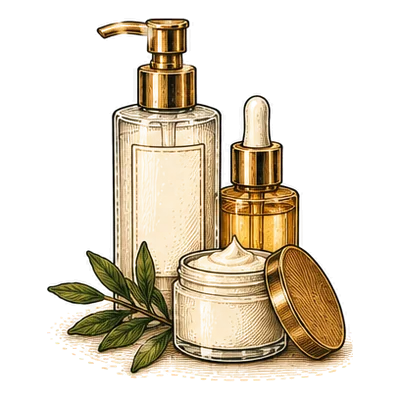
Three questions about your skin, and a four-step French pharmacy routine in return: a cleanser, a treatment, a cream and a sunscreen.
Build my routineAnd the “effortless” hair and makeup?
The same rule applies, which is that the effort is real and the goal is to hide it. The French word for the finished look is coiffé-décoiffé: styled, then unstyled. Nobody wakes up like that.
With hair, the work is moved to the salon. A good cut that falls into place on its own is treated as the investment, so that the daily routine can be short: washed less often than Americans wash, dried loosely or left to dry, and not straightened flat or curled into uniform waves. The slightly undone finish is the point, and it is what the cut was designed to produce.
With makeup, the order of priorities is reversed from the American one. Skin comes first, which is why the pharmacy matters so much, and colour comes second. The standard face is even skin, mascara, and either a strong lip or a defined eye, rarely both. Foundation that can be seen is considered a mistake.
None of this is less effort. It is effort spent in different places: on the cut instead of the blow-dry, on skincare instead of coverage. I find that more honest than “effortless”, and more useful, because it is something you can copy.
The unglamorous part that is actually true
Underneath the argument there is a boring answer nobody shares: sun protection, applied daily, for decades. That is the single most evidence-backed thing anyone does for how their face ages, and it is the thing the French pharmacy sells relentlessly and cheaply — with filters American brands cannot use. A twelve-euro cream is not doing the work people credit it with. Thirty years of not burning is.
So what do I tell the comment section?
That the question is unanswerable as asked, and that this is the honest answer rather than a dodge. Some French women get Botox. Some Americans do too, in far greater numbers by every published count. The real difference is that one culture treats the information as private and the other treats it as a public service. My husband’s contribution, for the record, was that he had never once wondered about this, which I have decided is its own kind of data point.
What is documented, and what is not
| Claim | Status |
|---|---|
| The US performs the most cosmetic procedures | Documented — ISAPS 2024 |
| Botulinum toxin is the top non-surgical procedure | Documented — 7.8M globally |
| France is not among the top countries by volume | Documented — absent from the 2024 ranking |
| French women get fewer procedures per head | Not established — no current data |
| French women secretly get many procedures | Not established — no data either way |
| French practice favours smaller, earlier treatment | Reported by practitioners, not measured |
| Daily sun protection affects how skin ages | Well established |
Questions, answered
Do French women get Botox?
Yes, some do. The idea that French women age without cosmetic help is a myth. What differs is disclosure rather than practice — in France, having work done is generally treated as private information rather than something discussed openly.
Do French women get less Botox than American women?
There is no current data that settles it. France does not appear in ISAPS’s 2024 ranking of leading countries by procedure volume, while the United States led with over six million procedures, but no recent per-capita comparison is published.
What is the French approach to ageing?
Practitioners describe a preference for earlier, smaller and less frequent treatment, with a strong aversion to a visibly altered result. The stated goal is to look well rather than to look treated.
What actually keeps French skin looking good?
The most evidence-backed factor is consistent daily sun protection over decades. French pharmacy sunscreens are inexpensive and use UV filters not approved in the United States, which makes daily use easier.
How do French women do their hair?
The look depends on a good cut that falls into place, washed less often and dried loosely, without heavy heat styling. The French call the finish coiffé-décoiffé, meaning styled and then deliberately undone.
What makeup do French women wear?
Typically little that is visible: even skin, mascara, and either a strong lip or a defined eye. Skincare is prioritised over coverage, and foundation that can be seen is avoided.
Sources
- ISAPS — 2024 Global Survey: 37.9M procedures worldwide, botulinum toxin the leading non-surgical procedure. ISAPS
- American Med Spa Association — country breakdown of the ISAPS 2024 results, including US, Brazil and Japan volumes. AmSpa
- ISAPS via Statista — injectable procedures performed in France in 2016, by type. Statista
Verified September 2026.