The most-asked question in our comments, after "where is he from," is some version of why does he look like that. Why the loafers at the grocery store. Why the bare ankles. Why the sweater lives on his shoulders like a small navy passenger. The answer is not vanity. The answer is a seven-year-old Parisian boy standing in front of a mirror while his father — who worked in fashion, and who had already fallen for New York by then — adjusted his collar and explained the rules. (He has since written his own account of those lessons; the record, as he puts it, is now correct.)
Your vote
Dressing up for a coffee run?
One tap. No email needed.
What did his father actually teach him?
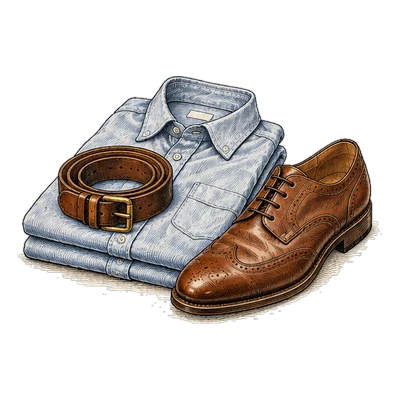
Not fashion. That's the part Americans find hardest to believe. His father taught pairing — that clothes speak to each other, and your job is to make sure they agree. The belt matches the shoes, always; brown with brown, black with black, and if you cannot match them you change one of them. Buy one good thing instead of five things. Trousers have a correct length, and it is shorter than America thinks. None of this was presented as style. It was presented the way table manners were presented in his mother's family — where a seven-year-old faced four forks at dinner and was expected to know the order — as basic consideration for the people who have to look at you.
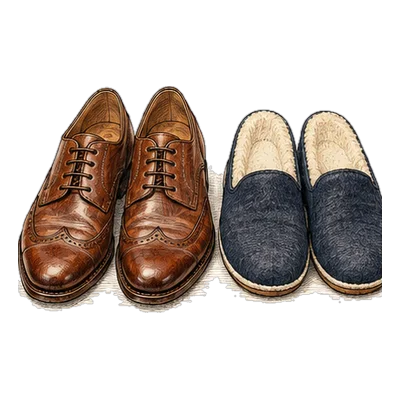
Summers belonged to his grandmother — his mother's mother, in Bordeaux — and to Cap Ferret, the pine-and-oyster peninsula across the bay, where the uniform is loafers, no socks, and a sweater over the shoulders in case the Atlantic changes its mind. Paris made him cool; his grandmother's Bordeaux made him correct. The tension between the two is, essentially, his entire wardrobe. Several French commenters diagnosed this on sight. One wrote, approximately, "this man has spent every summer of his life in Cap Ferret." The precision was unsettling. He read it and said, «Yes?» — genuinely unsure why it needed saying.
What are the actual rules?
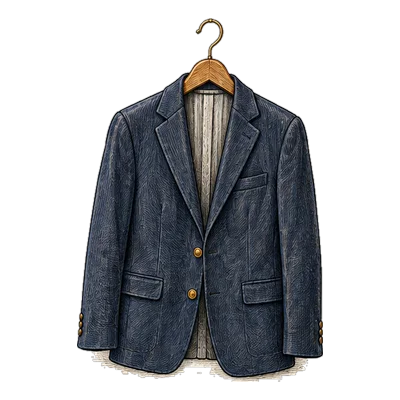
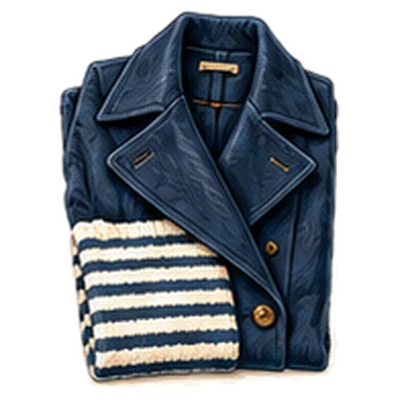
As far as I can reconstruct them from twelve years of observation: the belt-shoe accord, non-negotiable. The sweater on the shoulders — le pull sur les épaules — which functions as insurance, punctuation, and national identification all at once. Ankles shown from roughly April to October, a schedule he keeps without consulting weather or wife. One good navy blazer doing the work American closets assign to nine jackets. And a general principle he once summarized while watching me pack: «You do not need more. You need correct.» He was folding a single sweater at the time. We were leaving for a week.
Three of them, written for wives who would like to try them on a husband, close The French Fashion Field Guide, free.
Why doesn't he think any of this is fashion?
Because it was installed before he could evaluate it, from three directions at once: Paris gave him the edge, his grandmother gave him the class, and his father — who moved to New York when Sacha was five and came back carrying American boldness like a souvenir — gave him the radical idea that the two countries might have things to teach each other. Style, the way French children learn to eat what adults eat, he learned to dress the way adults dress, and by seven the system was running silently in the background. This is the thing the comments have started to figure out: he is not performing Frenchness. He dresses for Market Basket like it's a board meeting and sincerely believes this is casual. When Americans ask if his outfit is "a look," he experiences the question the way you'd experience someone asking if your handwashing is "a look." It is simply what one does.
And here is the twist the comments haven't fully caught yet: the wardrobe never actually left home. Cap Ferret and the New England coast are, functionally, the same civilization — oyster beds, pine trees, harbors full of sensible boats, old houses that whisper instead of shout. A man raised for the Bassin d'Arcachon arrives on the North Shore of Massachusetts and discovers his childhood uniform is already correct: the loafers, the bare ankles, the sweater standing by for the Atlantic's opinions. He may be the only immigrant in history whose packing required no adjustments. The oysters are different. He has remarks about this. The dress code, however, transferred without a single alteration.
It also explains the details the comment section keeps catching. The loafers at the playground. The blazer at American institutions he genuinely enjoys. The sweater that has crossed an ocean and never once been worn through its own sleeves. These are not choices, exactly. They are settings.
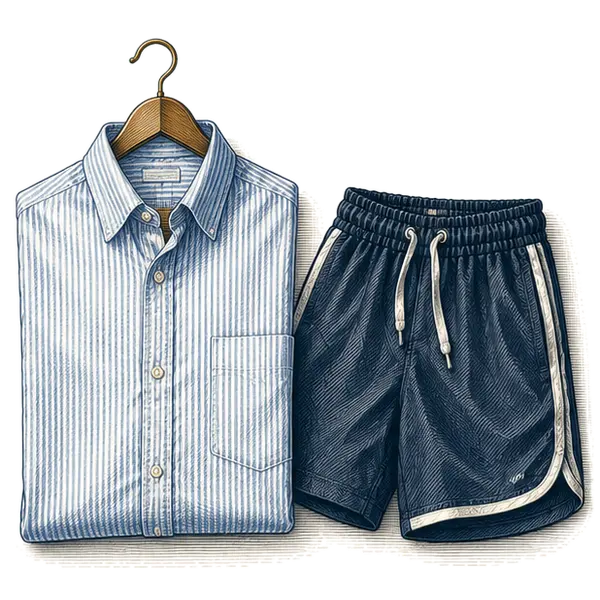
This or that
How French Is Your Husband?
“Awesome” or “not bad”? Shorts or a pressed shirt? Eight this-or-that questions about the man you live with.
Take the quizThe verdict
Something has shifted in our comments lately: people aren't just laughing at the mismatch anymore — they're learning the codes. They spot the belt-shoe accord. They demand to know whether he says pain au chocolat or chocolatine (he is Paris-raised with a Bordeaux grandmother, which makes this the single most dangerous question in our house). They diagnose Cap Ferret from a hundred yards. The audience is becoming fluent in him. He remains, as ever, the only person unaware there is anything to be fluent in — a man who got dressed this morning the way he was taught at seven, and cannot imagine why the internet is discussing his ankles — on a coastline that, if he squints past the Dunkin', looks remarkably like the one that raised him. For a fuller portrait of the specimen, his own writing is available.
Questions, answered
Do French men really match their belt to their shoes?
Broadly, yes — it's one of the most consistently taught French menswear rules: belt and shoes should agree in color and roughly in finish. Many French men learn it in childhood as basic correctness rather than fashion advice, which is why it's followed so automatically.
What is the sweater over the shoulders called?
In French it's le pull sur les épaules — the sweater on the shoulders, sleeves loosely knotted at the chest. It's part practicality (coastal weather changes), part inheritance: a summer-in-France signature so recognizable that commenters identify a region from it.
Is it pain au chocolat or chocolatine?
Both — and neither side will concede. Most of France says pain au chocolat; the southwest, around Bordeaux and Toulouse, says chocolatine and considers the matter settled. Choosing publicly is how you find out where everyone in the room grew up.
Still wondering?
Ask my French husband.
A short ruling in a few seconds. Written by AI from our Journal, in his voice.
For his verdicts delivered with unreasonable seriousness, we're on Instagram — and Le Bulletin gets field notes like this one.
Before you go
Is Your Closet French or American?
He has looked in my closet and he has notes. Your turn.