Your vote
Where should teenagers hang out?
One tap. No email needed.
Two answers to the same question
Every society has to put its teenagers somewhere. They are too old to be at home and too young to be anywhere that costs money, and they need a place to be seen by other teenagers, which is the entire point and always has been. America answered with the shopping mall. France answered with a chair on a pavement. Both are what sociologists call a third place — not home, not school — and the difference between them is almost entirely about how you pay rent on your own afternoon.
What the mall was actually for
Not shopping. Shopping was the cover story. The mall was climate-controlled, free to walk into, open late, and full of other people your age, and for about thirty years it was the only place in suburban America that met all four conditions at once. You went to be there. You bought a pretzel to justify being there. Every American who was fifteen between 1980 and 2010 understands the difference between going to the mall and going shopping, and every American parent pretended not to.
The café sells time, not coffee
This is the part that takes Americans a while, because the pricing looks like a scam until you understand what is being sold. The same espresso has two or three prices depending on where you drink it: cheapest standing at the bar, more seated inside, most on the terrace. You are not being charged for a better coffee. You are being charged for the chair, the street view, and an unstated but real permission to stay. In Paris that can mean roughly a euro and a half at the counter against three or four outside. Which sounds expensive until you notice it is a four-hour rate.
Nobody is going to ask you to leave
Service is included by law in France — service compris — so no waiter’s income depends on turning your table over. The result is that a single coffee holds a seat for an afternoon and this is so normal it is not discussed. A waiter may come out once to see whether you want another. Declining is fine. That is the whole negotiation. An American teenager who has spent years being moved along by a manager finds this almost suspicious.
The chairs face the street, which is the entire design
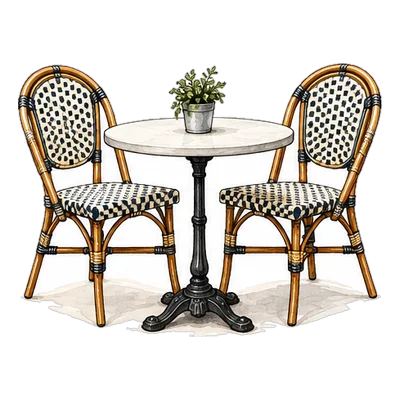
Terrace chairs are turned outward, toward the pavement, rather than inward toward the table. That is not a space-saving accident. Sitting beside someone watching the street go past is a recognised way to spend time with them, equal in standing to talking. The French have a word for the unhurried watching — flânerie — and no apology attached to it. The mall, by contrast, has no windows at all, and that is also deliberate: nothing inside should remind you there is weather, or a time of day, or anywhere else to be.

The real difference is a driving licence
Here is the structural fact underneath the cultural one. An American teenager needs a car, or someone else’s car, to reach the mall — which is why it sits off a highway with a parking lot around it, and why the American mall afternoon begins and ends with a lift. A French teenager walks, or takes the métro, and the café is on the corner. Independence arrives at sixteen in one country and is simply always present in the other, and the buildings follow from that rather than the other way round.

This or that
Were You a French or an American Teenager?
Mall or café? Minivan or scooter? Six this-or-that questions on growing up, his way or mine.
Take the quizOne of them did not survive
The mall is in trouble and has been for a decade: vacancy near nine percent entering 2026, roughly twice the rate of retail generally, about forty large malls closing every year through the late 2010s, and no new enclosed megamall built in America since 2019. The interesting part is what replaced it, which is mostly nothing. The terrace, meanwhile, has needed no reinvention, because it was never a retail format pretending to be a public square. It was just a public square with coffee.
The song in the reel is about a mall twenty minutes from our house
The track is “Liberty Tree” by Phoebe Bridgers, from Lost Weekend, released in August 2026. It is named for the Liberty Tree Mall in Danvers, Massachusetts — which is about twenty minutes up Route 128 from us, and which is exactly the kind of half-empty mall this whole piece is about. Bridgers has described it as a song about falling in love in a hopeless place. Bo Burnham, who grew up nearby, once described the mall as somewhere kids could feel free without actually being free — which is the most precise description of the American mall I have found, and it took me an article to get nowhere near it.
So who had the better adolescence?
His, and I say that as someone who loved the mall. But the honest version is that he had the better infrastructure, not the better childhood. A terrace requires a walkable street, a café that tolerates you, and a culture that does not treat a teenager occupying a chair as a problem to be managed. America built its suburbs so that none of those things could exist, and then built the mall to replace all three at once, indoors, on private land. It worked for about thirty years. That is not nothing. It is just not a street.
The same afternoon, two countries
| American mall | French terrace | |
|---|---|---|
| Getting there | Car, or a lift from someone | Walk, or the métro |
| Cost of entry | Free — but you should buy something | One coffee, paid once |
| How long you may stay | Until someone moves you along | As long as you like |
| What you look at | Shops, and other teenagers | The street, and other people |
| Who owns the space | A real-estate trust | The café, and the pavement |
| Weather | Never mentioned | The entire point |
| Still there in 2026? | Fewer every year | Unchanged |
Questions, answered
Why does coffee cost more on the terrace in France?
Because you are paying for the seat and the street view, not a different drink. French cafés post separate prices for standing at the bar (au comptoir), sitting inside (en salle) and sitting outside (en terrasse). The higher price includes the right to stay as long as you like.
Can you sit in a French café for hours with one drink?
Yes, and it is completely normal. Service is included by law, so no one’s income depends on turning your table over. A waiter may ask once whether you want another drink; declining is perfectly acceptable.
Why did American teenagers hang out at the mall?
Because it was the only place in suburban America that was free to enter, climate-controlled, open late and full of other teenagers. Shopping was largely the pretext. The mall functioned as a third place — somewhere that was neither home nor school.
Are American malls disappearing?
They are shrinking. US mall vacancy was about 8.8% entering 2026, roughly double the rate for retail overall, and no new enclosed megamall has been built in America since 2019. Many surviving malls are being redeveloped into mixed-use sites.
Still wondering?
Ask my French husband.
A short ruling in a few seconds. Written by AI from our Journal, in his voice.
Sources
- The Local — French café terrace etiquette, including how long one coffee buys you. The Local
- Capital One Shopping — US mall vacancy, closure rates and the absence of new megamalls. Capital One Shopping
Verified September 2026.
He judges America weekly on Instagram, and Le Bulletin collects the best of it.

Before you go
Your First Day in Paris
You land in Paris at nine in the morning. He is watching what you do next.