I came home with a trophy. Not mine: Owen’s, for taking part. He is four. I was thrilled. Sacha looked at the shelf, which already holds a small collection, and at Harry’s. Harry is two, and he already has a participation medal from a bike event he did before he could walk. Wells, the baby, has no medals yet. Give it time. This week’s débat: does a medal for everyone build confidence, or does it teach children that showing up is the same as winning?
 No. 03
1. Who gets a medal
“In France, the kids didn’t all get medals. Not a lot of people get one. The one who is first, second or third ends up with the trophy, and the others know they have to work harder to get there. I grew up with maybe one or two.”
In America, every child who plays gets a medal. “I love that.” Owen, our four-year-old, already has a bunch of medals and a trophy. Little boys here grow up with a wall of them in their bedroom, and they are proud of every single one.
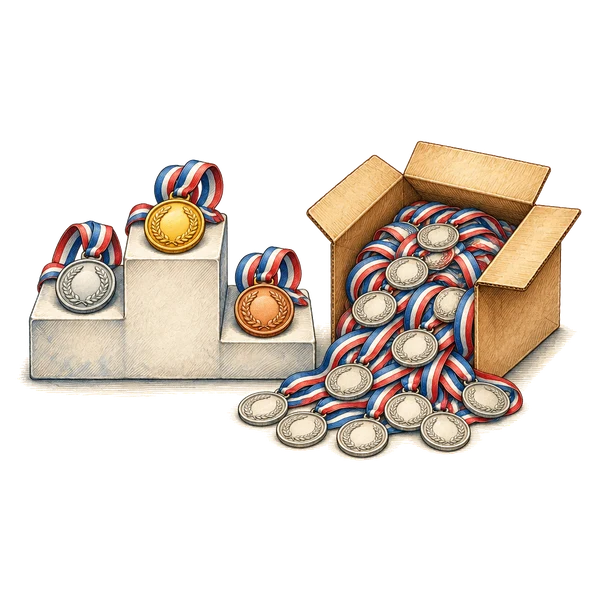
That is our house in one shelf. Owen has a collection. Harry is two and already has a participation medal from a bike event he did before he could walk. Wells has none yet, which by American standards makes him a late bloomer. And Sacha, who grew up in France, had maybe one or two in his whole childhood.
2. Does it build confidence?
“In the US, do they feel like they’re good at everything, so they’re not working as hard for it? But at the same time, in France, maybe we don’t give them the confidence that they’re good at it.”
A four-year-old does not need to be ranked. The medal says you came, you tried, you belong on the team. That is how you get a child to come back next Saturday.
This is the real argument in our house. Sacha is not against Owen feeling good. He worries that if everything earns a medal, nothing has to be worked for. I am not against Owen working hard. I just think that at four, the point of the medal is that he wants to go back next Saturday.
For what it is worth, the research sits somewhere between us: praise the effort, not the child. More on that below.
Your vote
A medal for everyone, or only for the podium?
One tap. No email needed. Results next Wednesday.
3. Does a medal mean less when everyone gets one?
“If you overdo it, does it lose its value? Does it lose its meaning? My son is four and he already has more medals than I had in my whole childhood.”
He keeps every one. To him, a medal is a memory of a Saturday, not a ranking.
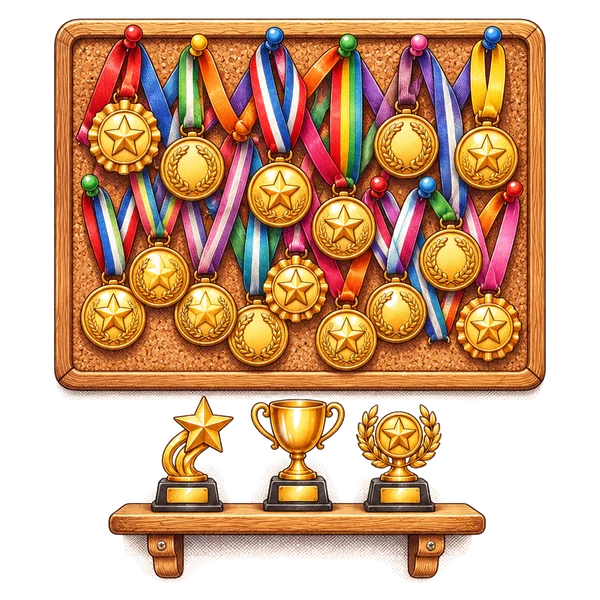
Sacha’s question stays with me every time a new one goes on the shelf. When the shelf is full, does the next medal still mean anything? I do not have an answer. I just keep making room.
4. Does the French way crush confidence?
“The French way is tough. You have to work hard, you have to earn it. Not a lot of people do it.”
“A four-year-old should not already know he is not good enough. We must protect him from real life.”

Sacha grew up the other way. First, second and third went home with something; everyone else went home knowing where they stood, and, he says, worked harder for next time. I wonder what it did to the ones who never made the podium. Even French school works like that: grades go out of 20, and an old saying gives 20 to God, 19 to the teacher and 18 to the best student. How the French grading system works.
5. Why do kids quit?
“In America, it is such a reward for them to participate.”
Children quit when it stops being fun. If a medal keeps a little one coming back, it has done its job.
This is where I dig in. Children quit sports when it stops being fun: in a 2019 survey of American sports parents, kids quit at around eleven, most often because they had stopped enjoying it. If a medal at four keeps Owen playing at twelve, I will buy more shelves.
The official test
Do You Parent French or American?
Snacks, bedtime, saying no, and now medals. Find out which side of the table you sit on.
Take the quizSo who is right?
We have not settled it. Maybe we are both right, at different ages: at four, a medal for showing up is a reason to come back; at ten, a medal for showing up is a ribbon nobody believes.
For now Owen keeps his shelf, Sacha keeps his one or two medals, and Wells keeps his options open. Tell us who is right.
Announced Wednesday, Dec 2
A medal for everyone, or only for the podium: your votes decide it. The result goes here.
Your turn
What should we argue about next?
No sign-up needed. We read every one.
Questions, answered
Are participation trophies bad for kids?
The research does not say a ribbon harms anyone. What it does show is that the message matters: in Mueller and Dweck’s 1998 studies, children praised for being smart gave up sooner after a hard problem than children praised for their effort. A trophy that says “you showed up and worked” is closer to effort praise; one that says “you are a winner” whatever happened is not.
Do French kids get participation medals?
Less often, in our experience. Sacha grew up in France with one or two medals, won on a podium. French school also grades out of 20, and an old saying goes that 20 is for God, 19 for the teacher and 18 for the best student.
How many Americans think every child should get a trophy?
In a 2014 Reason-Rupe poll of 1,000 American adults, 57% said only the winners should get trophies and 40% said every child on the team should. Younger adults, women and lower-income households were the most in favour of trophies for all.
Why do kids quit sports?
According to the Aspen Institute’s 2019 survey of sports parents, children quit a sport after about three years, at around age 11 on average, and the most common reason, 36% of the time, was that they stopped enjoying it.
What builds confidence in children, winning or trying?
Praising specific effort and strategy holds up best in the research. Confidence that comes from being told you are good, whatever happens, tends to break at the first failure; confidence that comes from having worked for something tends to last.
Sources
- Reason-Rupe poll, August 2014: 1,000 adults, 57% winners only, 40% every child.
- Mueller and Dweck, “Praise for intelligence can undermine children’s motivation and performance”, Journal of Personality and Social Psychology, 1998.
- Aspen Institute Project Play, Kids quit most sports by age 11 (2019): 1,032 sports parents; 36% of quits because the child stopped enjoying it.
- Connexion, Do French schools deserve their harsh reputation? (May 2022): the 20/19/18 saying; François Dubet.
- Wikipedia, Participation trophy: earliest known mention, 1922.