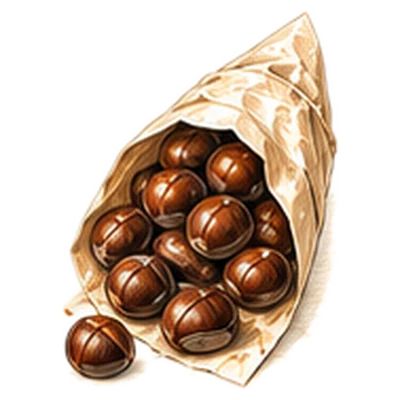
You smell them before you see them. You come up the metro stairs on a cold evening and there it is: a man over a smoking drum, a pan full of holes, chestnuts splitting open on the coals. Chauds, les marrons, chauds ! A few minutes later you’re holding a paper cone that’s too hot to hold, peeling something that’s too hot to peel. And you’re happy.
My French husband says this is how you know Paris has switched to autumn. Not the leaves. The chestnuts.
Your vote
Chestnuts from a street cart?
One tap. No email needed.
What are marrons chauds?
Marrons chauds (“hot chestnuts”) are chestnuts roasted in their shells over open coals and sold by the paper cone. The cone used to be rolled from old newspaper. The setup is usually improvised: a shopping cart, a tin of glowing charcoal, a perforated metal disc on top. You eat them standing up or walking, never at a table.
Where can you buy roasted chestnuts in Paris?
Wherever people walk in the cold. Look for them:
- outside busy metro exits and along the big shopping streets, especially by the department stores once the Christmas windows go up
- on the Champs-Élysées and up in Montmartre near Sacré-Cœur
- at the Christmas markets, where they sit next to the vin chaud
- in parks and along the Seine at dusk
There’s rarely a posted price. Ask before they start scooping. And if you are still working out which Paris is yours, Where is your Paris? matches your neighborhood at home to one there.
Are street chestnuts in Paris legal and safe?
Short answer: they’re a beloved tradition, and many of the carts are not licensed. French rules have long carved out an exception for hot chestnuts on the street, but many Paris cart sellers work without authorization, often with an eye out for the police. Near the Eiffel Tower, the city runs regular sweeps of hidden vendor stock; in one October 2023 operation, municipal police seized 15 kg of chestnuts along with braziers and drinks.
The roasting itself is the safe part: shells on, over hot coals. The risk is everything around it, like where the raw chestnuts were stored. Our rules:
- buy from someone roasting right in front of you
- pick a cone that’s hot all the way through
- choose chestnuts that have split open and look cooked, not pale
- skip carts in the most touristy spots, where storage is the most questionable

Quiz
How Parisian are you, really?
Home, food and beauty. Eight questions, one minute, one verdict you may not like.
Take the quizMarron or châtaigne: what’s the difference?
The cart says marrons. My husband will tell you, gently and more than once, that it’s complicated. Both words name the fruit of the chestnut tree. Botanically, a marron is a cultivated variety with one large nut per spiky husk; a châtaigne has two or three smaller ones. In everyday French, “marron” won for anything cooked or sweet. Nobody is correcting the man with the fire.
| Marron | Châtaigne | Marron d’Inde | |
|---|---|---|---|
| What it is | Cultivated chestnut, one big nut per husk | Chestnut, 2 to 3 nuts per husk | Horse chestnut, from the city’s ornamental trees |
| Edible? | Yes | Yes | No, toxic |
| Where you meet it | Marrons chauds, marrons glacés, crème de marrons | Markets, flour, soups; Ardèche AOP | Park paths in October |
The one rule that matters: don’t let the kids bring home the shiny conkers from the park for dinner.
How do you eat them like a Parisian?
Pick the ones that split. Press the shell between thumb and finger, peel it back, then rub off the thin, bitter skin underneath. Eat it while it’s still too hot. Use the cone as a hand warmer. Share, but watch the last one.
How do you make Paris-style roasted chestnuts at home?
No drum, no smoke, same joy. It takes about 40 minutes.
What else do the French do with chestnuts?
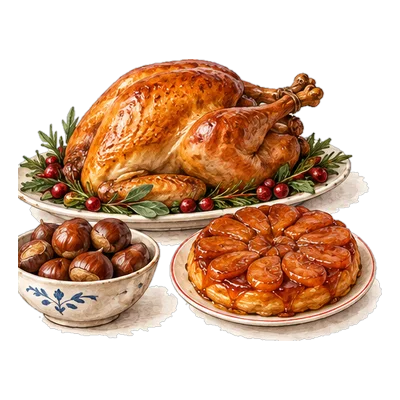
The cone is just the start. Chestnuts follow the French all the way to Christmas: marrons glacés in gift boxes, crème de marrons from the little tin spread on crêpes, chestnut soup, chestnuts next to the holiday bird (they are in the stuffing on our French Thanksgiving menu), and the Mont-Blanc dessert. The Ardèche grows about half of France’s chestnuts, and its fresh chestnuts, dried chestnuts and flour carry a protected AOP label.
For the rest of the French table, What’s for Dinner? The French Way picks tonight’s dish for you, and these are the French foods Americans won’t eat. The Field Guide has the rest of the house rules.
Questions, answered
Are roasted chestnuts from Paris street vendors safe to eat?
The roasting is safe: they cook in the shell over hot coals. The risk is how the raw chestnuts were stored, since many carts are unlicensed. Buy from someone roasting in front of you and eat them hot.
When can you buy roasted chestnuts in Paris?
From the first cold weeks of autumn through the Christmas markets in December, mostly in the late afternoon and evening.
What is the difference between a marron and a châtaigne?
A marron is a cultivated chestnut with one large nut per husk; a châtaigne has two or three. Both are edible. The marron d’Inde, or horse chestnut, is toxic.
Sources
- Paris.fr, “Vente à la sauvette : l’opération « vide-cache » de la police municipale” (updated November 2023): 15 kg of chestnuts seized near the Eiffel Tower in one operation.
- Assemblée nationale, written question no. 147 (1997): street food sales and the exception for hot chestnuts, peanuts, ice cream and sweets.
- Gault&Millau, “Marron ou châtaigne ?”
- Taste France, Châtaigne d’Ardèche AOP.
- Webzine Voyage: the Ardèche and about half of French chestnut production.
- Sticky Mango Rice, on Paris chestnut roasters (2021): the cart setup, unlicensed sellers, no fixed price.
- Home method cross-checked against Saveur and Tasting Table.
Still wondering?
Ask my French husband.
A short ruling in a few seconds. Written by AI from our Journal, in his voice.
He judges America weekly on Instagram, and Le Bulletin collects the best of it.
Before you go
Where is your Paris?
Tell me your neighborhood at home. I’ll tell you yours in Paris.