Your vote
Butter on radishes?
One tap. No email needed.
What is radis beurre?
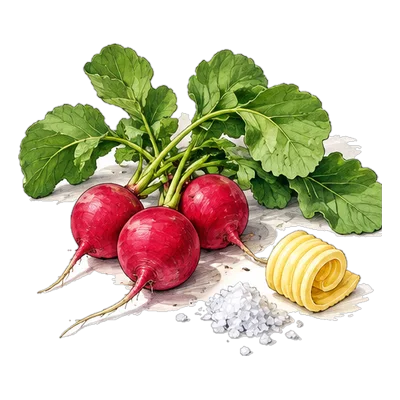
Raw radishes, cold unsalted butter and flaky salt, served together and assembled by whoever is eating. It is one of the oldest and simplest things on a French table, and it survives because there is nothing in it to get wrong except the temperature.
Which radish is a French radish?
Look for the French breakfast radish, sold in France as radis demi-long or radis de 18 jours: elongated, pink-red with a white tip, and milder than the round red radishes in most American supermarkets. In France it comes in a bunch with the leaves still on, and the leaves tell you how fresh it is: they should be green and upright. Round radishes work too; halve the large ones.
The name radis de 18 jours is a growing time: under ideal conditions it is ready to pull about 18 days after sowing. French growers bred it down to that, from about 25 days, then 20, then 18, which is why it is the radish on most French market stalls.
| French breakfast radish | Round red radish | |
|---|---|---|
| In France | Radis demi-long, radis de 18 jours | Radis rond |
| Shape | Long, pink-red with a white tip | Round, red all over |
| Taste | Mild, crisp, lightly peppery | Sharper, hotter as it grows |
| Sold | In a bunch, leaves on | Often in a bag, leaves off |
| For radis beurre | The classic | Fine if small; halve the large ones |
Why butter on a radish?
Because a radish is peppery, watery and slightly harsh, and butter is fat and salt is sharp. The fat rounds the bite off and carries the pepper, and the salt gives it a crunch the radish does not have on its own. It is a complete idea in three parts, which is why nobody has improved it in a century.
How healthy are radishes with butter?
The radish is almost nothing: 95% water and 16 calories per 100 g (3½ oz), with 14.8 mg of vitamin C, according to the US Department of Agriculture’s FoodData Central. The butter is the calories: about 717 per 100 g, so roughly 36 for a teaspoon (5 g). A plate of radishes with a teaspoon of butter is a small thing before dinner, which is exactly the point of the apéritif: something to hold with a drink, not a meal.
Radishes with butter: a French snack?
This is the part that gets lost in translation. It is not eaten between meals — the French do not really do that, as we have written about at some length. Radis beurre is apéro: the drink before dinner, at a fixed hour, with people. Calling it a snack moves it into a category France does not have. It sits alongside nine other things Americans call appetizers and the French mostly call entrées: they are all in his guide to appetizers in French.
“It is just raw butter”
This is the objection, and it comes up every time. The answer is that it depends entirely on the butter, which is why the dish is unforgiving. French butter is legally at least 82% butterfat against an American minimum of 80%, and it is usually cultured, which gives it a faint tang — we have written about why that gap exists. With good butter this is not raw fat, it is a cold, slightly sour, salted thing against a hot peppery one. With cheap sweet-cream butter it genuinely is bland, and the people saying so are not wrong about what they ate. In the United States the most available fix is an imported European-style butter — Kerrygold is the one our comment section keeps naming, and it clears the bar.
The official test
Could You Survive a French Dinner Party?
When to arrive, what to bring, where to put your hands. Eight questions. I failed all of them in real life.
Take the quizWhere is the bread?
Also a fair question, and the honest answer is that both versions are real. The strict apéro version is radish, butter, salt, eaten by hand with no bread at all. The other version is a tartine: baguette, a thick layer of butter, radishes sliced thin on top, salt over that. Bread is not a correction to the dish — it is a second form of it. If you are eating standing up with a drink, no bread. If you are sitting down, bread.
Whole or sliced, and which salt
Two schools, and the comments contain both. Whole is the traditional apéro form: you hold the stem, drag it through the butter, dip. Sliced thin is the tartine form and it spreads the pepper more evenly, which some people prefer and which is easier if the radishes are large. On salt, use flaky — fleur de sel if you have it. Fine table salt dissolves into the butter and disappears, and the crunch of the salt is a third of the point. There is also genuine regional variation across France in how this is served, and nobody agrees, which is normal.
What he says about the American version
That the radishes are too big. This is a real objection rather than a stylistic one — large radishes are woodier and more bitter, and the small bunched ones sold with leaves attached are a different eating experience. He also objects to pre-sliced radishes on a board, on the grounds that the stem is the handle and removing it creates work that did not need to exist.
Questions, answered
What butter should I use for radis beurre?
Use a European-style butter with at least 82% butterfat, unsalted, and keep it cold. American standard butter is 80% minimum and usually uncultured, which is why the dish can taste flat made with it. In the United States, Kerrygold and similar imported butters clear the bar.
Do you eat radis beurre with bread?
Both versions exist. The apéritif version is radish, butter and salt eaten by hand with no bread. The tartine version is buttered baguette with thinly sliced radishes and salt on top. Neither is wrong — standing up, no bread; sitting down, bread.
What is radis beurre?
Radis beurre is a classic French apéritif dish of raw radishes served with cold unsalted butter and flaky salt. The radish is dragged through the butter, dipped in salt and eaten in one bite. There is no cooking involved.
Why do the French eat radishes with butter?
Because butter softens the radish’s peppery bite and carries it, while flaky salt adds crunch and sharpness. The three ingredients balance each other, which is why the combination has lasted.
Are radishes with butter a French snack?
Radishes with butter, radis beurre, is often called a French snack in English, but in France it belongs to the apéritif, the scheduled drink before dinner, rather than to eating between meals.
How many calories are in radishes with butter?
Very few from the radishes, about 16 calories per 100 g. The butter carries the calories, roughly 36 per teaspoon (5 g), according to USDA FoodData Central.
What is a French breakfast radish?
An elongated radish, pink-red with a white tip, sold in France as radis demi-long or radis de 18 jours. It is milder and crisper than a round red radish, which is why it is the classic choice for radis beurre.
Still wondering?
Ask my French husband.
A short ruling in a few seconds. Written by AI from our Journal, in his voice.
He judges America weekly on Instagram, and Le Bulletin collects the best of it.
Before you go
Do You Parent French or American?
He parents one way and I parent the other. Find out which one you are.