The French bottled water versus American bottled water argument started, as most of these do, in a supermarket aisle. He picked up a bottle of Dasani, turned it over, read the ingredients list, and put it down again without saying anything, which from him is a paragraph.
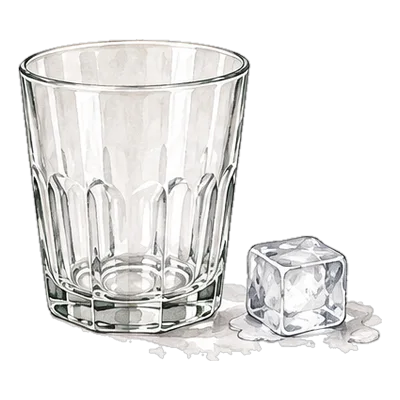
So we poured five into identical glasses and covered the labels: Evian, Fiji, Dasani, Poland Spring — and, because the exercise needed a control he did not consent to, a Monster energy drink. He was told only that some were from home.
He picked the Evian. He was polite about the Fiji. The Monster was identified immediately and discussed at length.
Your vote
Water on the table?
One tap. No email needed.
What is the difference between French and American bottled water?
The difference is legal before it is ever a matter of taste. In France, the category on the label is a regulated promise about where the water came from and what has been done to it since. In America, the dominant category is a promise about what has been removed.
- eau minérale naturelle (oh mee-nay-RAL na-tew-REL)
- Natural mineral water: drawn from a single protected underground source, bottled at that source, with a stable mineral composition that must be printed on the label and may not be altered. Evian and Volvic are both this.
- eau de source (oh duh SOORS)
- Spring water: also from a protected underground source and also bottled without treatment, but not required to hold a constant mineral profile. Cristaline is this, which is exactly why it can draw from more than twenty springs across France and stay cheap.
American purified water is a different proposition entirely. Aquafina begins as municipal tap water and runs through a seven-stage process built around reverse osmosis — PepsiCo added "public water source" to the label in 2007 after pressure from consumer groups. Dasani starts the same way and then adds minerals back for flavour.
Evian, Volvic or Cristaline: which French water is best?
They are not competing for the same job, which is the part Americans tend to miss.
Evian is the mineral-heavy one, at 345 mg per litre of dissolved solids from the Cachat spring above Lake Geneva. It is the one that tastes, faintly, of something. Volvic is the light one, 130 mg per litre, filtered through six layers of volcanic rock in the Auvergne — the water French parents buy for babies. Cristaline is the one that actually lives in French kitchens. Created in 1992, priced deliberately below everything else, and for years running the best-selling still water in France. Nobody is romantic about it. Everybody has a crate of it in the garage.
This is the gap between what France exports and what France drinks — the same gap that shows up in how butter is sold on either side of the Atlantic. Evian is the ambassador. Cristaline is the citizen. All three carry his stamp — the reasoning for each is set out below.
French bottled water brands: the list
These are the French water brands you will actually meet in a French supermarket, and the ones most often exported. Still first, then sparkling.
| Brand | Type | Where it comes from | Known for |
|---|---|---|---|
| Evian | Still, natural mineral | Évian-les-Bains, Haute-Savoie | The export. Rounded, lightly mineral. |
| Volvic | Still, natural mineral | Auvergne volcanic aquifer | Light and low in minerals. |
| Vittel | Still, natural mineral | Vittel, Vosges | The middle-of-the-road table water. |
| Contrex | Still, natural mineral | Contrexéville, Vosges | Very high in calcium and magnesium. A taste you notice. |
| Hépar | Still, natural mineral | Vittel, Vosges | The magnesium-rich one. |
| Thonon | Still, natural mineral | Thonon-les-Bains, Haute-Savoie | Evian’s quieter neighbour on the same lake. |
| Mont Roucous | Still, natural mineral | Tarn | Extremely low in minerals. |
| Cristaline | Still, spring water | 20+ regional springs | The cheap one in every French kitchen. |
| Perrier | Sparkling | Vergèze, Gard | Big bubbles. The green bottle. |
| Badoit | Sparkling, natural mineral | Saint-Galmier, Loire | Fine bubbles. The restaurant table water. |
| Salvetat | Sparkling, natural mineral | La Salvetat-sur-Agout, Hérault | Soft and lightly sparkling. |
| Saint-Yorre | Sparkling, natural mineral | Saint-Yorre, Allier | Salty and rich in bicarbonate. Divisive. |
| Vichy Célestins | Sparkling, natural mineral | Vichy, Allier | The old spa-town water. |
If you are choosing by taste: Volvic or Mont Roucous for something neutral, Evian or Vittel for the middle, Contrex or Hépar if you want to taste the geology. For sparkling, Badoit at the table and Perrier when you want it to bite.
How do Poland Spring, Dasani and Aquafina compare?
Poland Spring is the one an ordinary French person would recognise as water in the sense they mean it: spring water from Maine, sold on the strength of its source. Its corporate history is busier than its taste — Nestlé sold the North American water business in 2021, it became BlueTriton, and BlueTriton merged with Primo Water in November 2024 to form Primo Brands, which now owns Poland Spring along with Deer Park, Arrowhead and Ozarka.
Fiji, which was in our glasses and is neither French nor American, is artesian water from Viti Levu owned by the American Wonderful Company — a genuine remote source sold at a premium, and the one he had least to say about.
Dasani and Aquafina are the ones that require an explanation. Both begin at the municipal tap. Aquafina strips the water down to almost nothing — below 10 parts per million of dissolved solids — and adds nothing back, which is a deliberate choice: no minerals means no mineral taste, and the brand sells neutrality. Dasani purifies to the same baseline and then adds magnesium sulfate and potassium chloride for what Coca-Cola calls a crisp taste.
Which produces the single sentence he offered when the exercise was explained to him afterwards:
"So the American water is a recipe. In France, water has an address."
The official test
How American Are You?
Ice, coffee, pumpkins and pajama pants. Eight questions, graded by a Frenchman.
Take the quizFrench and American bottled water, side by side
| Water | Country | Category | Source | Owner | MFH verdict |
|---|---|---|---|---|---|
| Evian | France | Natural mineral water | Cachat spring, Évian-les-Bains | Danone | Approuvé |
| Volvic | France | Natural mineral water | Volcanic aquifer, Auvergne | Danone | Approuvé |
| Cristaline | France | Spring water | 20+ regional springs, named per bottle | Sources Alma | Approuvé |
| Poland Spring | USA | Spring water | Springs in Maine | Primo Brands | Hors concours |
| Dasani | USA | Purified, minerals added | Local municipal supply | Coca-Cola | Hors concours |
| Aquafina | USA | Purified | Public water source | PepsiCo | Hors concours |
The verdict column applies the MyFrenchHusband Approved test: is the company French, is it made in France, and do French people actually buy it? The three American waters never claimed to be French, so they are marked hors concours — not French, not judged. Verified August 2026.
Watch the tasting
Five glasses, no labels, and a man who was told this would take five minutes. Evian won. The Monster was not forgiven.
The verdict
The tasting is the entertainment. The label is the answer. A French natural mineral water has to tell you where it came from and may not be altered on the way to the bottle; an American purified water tells you what was taken out and, in Dasani’s case, what was put back in. Both are fine to drink. Only one of them has an origin.
He picked the Evian blind, which proves less than it looks like it proves — it is the most mineral-heavy glass on the table and the easiest to pick out. The more useful fact is the one no tasting can show you: the water France actually drinks is Cristaline, the one nobody outside France has heard of. That is usually how it goes.
Questions, answered
What are the main French bottled water brands?
The main still brands are Evian, Volvic, Vittel, Contrex, Hépar, Thonon and Cristaline. The main sparkling brands are Perrier, Badoit, Salvetat, Saint-Yorre and Vichy Célestins. Cristaline is the everyday supermarket water; Evian and Perrier are the ones most often exported.
What is the best French bottled water?
It depends what you want it to taste like. Evian is the mineral-rich one, at 345 mg per litre of dissolved solids, with a rounded, slightly heavy mouthfeel. Volvic is the light one, at 130 mg per litre, filtered through volcanic rock in the Auvergne. Cristaline is the everyday one that most French households actually buy, because it is the cheapest.
Is Dasani just tap water?
Essentially, yes — with additions. Coca-Cola starts with the local municipal water supply, purifies it by reverse osmosis, then adds a blend of magnesium sulfate and potassium chloride for taste. The label lists those minerals as ingredients. It is not spring water and does not claim to be.
Why does French bottled water taste different?
Because French natural mineral water must come from one protected underground source and cannot be altered, so its mineral composition — and therefore its taste — is fixed by geology. American purified brands like Aquafina strip dissolved solids down below 10 parts per million, removing the minerals that give water flavour in the first place.
Still wondering?
Ask my French husband.
A short ruling in a few seconds. Written by AI from our Journal, in his voice.
Sources
- Sources Alma — Cristaline's classification as spring water and its network of regional sources. Sources Alma
- The Washington Post, July 2007 — PepsiCo's decision to state the public water source on Aquafina labels. Washingtonpost
- Primo Brands — completion of the Primo Water and BlueTriton merger, November 2024. Prnewswire
Ownership and label figures verified August 2026.
For his verdicts delivered with unreasonable seriousness, we're on Instagram — and Le Bulletin gets field notes like this one.
Before you go
Could You Survive a French Dinner Party?
I failed my first French dinner party. See if you would do better.