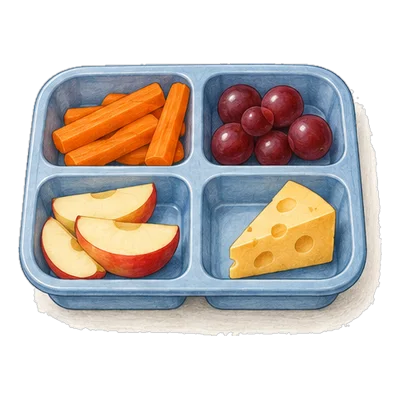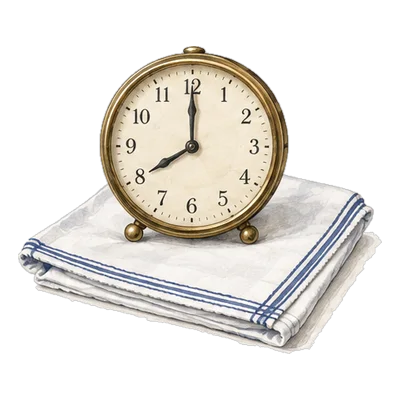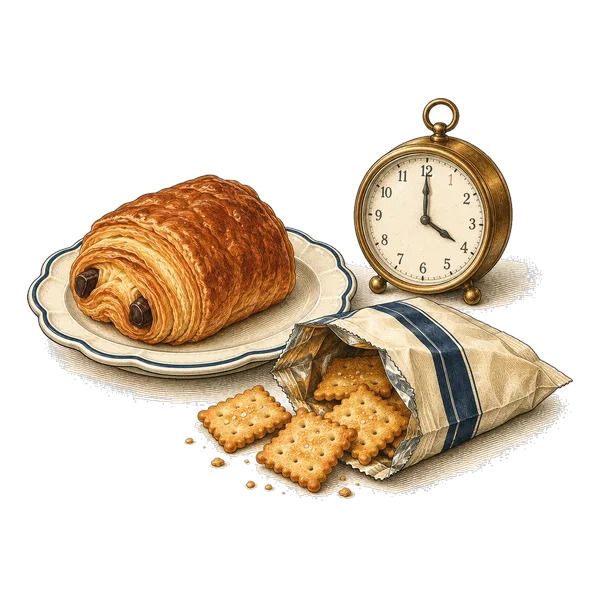

Every day at four o'clock, in millions of French households, something happens that does not happen in America: the snack is scheduled. It has a name — le goûter (pronounced goo-TAY) — a fixed time, an approved menu, and centuries of cultural enforcement behind it. My husband treats it the way other people treat religious observance. Our three boys, born in New England, are being raised inside it.
Your vote
Snacks for the children?
One tap. No email needed.
The definition, officially
a goûter is the French fourth meal — a small, sweet snack eaten around 4 to 4:30 p.m., almost exclusively by children (and by adults who claim they're only having it to keep the children company). It exists because French dinner happens late — 7:30, 8, sometimes later — and a child released from school at 4 cannot cross that desert unassisted.
What's actually in it
bread. Mostly bread. A piece of baguette with a bar of dark chocolate pressed inside it is the canonical goûter — pain au chocolat's rustic ancestor. Otherwise: a slice of brioche, a pain au lait, plain yogurt, fruit, a madeleine, a few petit-beurre biscuits. The portions are small. The sugar is moderate. And critically, it is one snack, once — not an afternoon of grazing.
Which is the real difference.
When my husband first watched American children snack — the pouches in the car, the Goldfish at the playground, the granola bar at 2, the fruit snacks at 3, the crackers at 5 — his observation was not about the food. It was about the clock. "In France," he said, holding a single madeleine like evidence, "children are hungry at dinner. This is not an accident. It is the goûter's entire job." The French snack exists to protect the appetite; the American snack exists to eliminate it. Two countries, two philosophies, one very smug man at my kitchen counter.
What does goûter mean?
It comes from the verb goûter, to taste. As a noun it means the afternoon snack, and as a verb French children use it for the act itself: on goûte ? means “is it snack time?”
You will also hear le quatre-heures, literally “the four o’clock”, which tells you everything about how fixed the time is. It is pronounced goo-TAY, and the plural is the same word.
This or that
Do You Parent French or American?
Snacks on demand or four o’clock sharp? The car line or walking alone? Eight this-or-that questions.
Take the quizEasy goûter ideas you can make in America
None of these need a French grocery store. The rule is one item, or two small ones, eaten sitting down, with water or a glass of milk.
Bread and chocolate. A piece of baguette with two squares of dark chocolate pushed into it. This is the classic.
A tartine. A slice of bread with butter and jam, or butter and honey.
Plain yogurt and fruit. Whole-milk yogurt with a spoon of jam stirred in, and a clementine or an apple.
Compote. Unsweetened apple sauce, in a bowl, with a plain biscuit.
Something baked at the weekend. A slice of yogurt cake, a madeleine, or a crêpe with sugar.
I tested the American supermarket for this, aisle by aisle, in a French goûter from American groceries.
How is it different from an American after-school snack?
Three ways, and none of them is the food. It happens once, at a set time, and not again before dinner. It is eaten at a table, not in the car or in front of a screen. And an adult decides what it is. The French call eating between meals grignoter, to nibble, and they do not mean it kindly.
That structure is why dinner at eight works for children. The goûter is the bridge, and there is only one bridge.
Test yourself
The goûter test
Five questions on the French four o’clock snack. Tap an answer to see the rule.
Does it work?
Honestly — mostly, yes. Our boys eat one goûter at four and arrive at dinner hungry, which is the only parenting magic trick I've seen function reliably. Do they also know what Goldfish are? They live in Massachusetts. Of course they do. The house policy is French rules, American exceptions — which, come to think of it, is the whole marriage.
The goûter is one line in a longer list. Bedtime, school at three and screens are side by side in French parenting vs American parenting.
Questions, answered
What time is goûter in France?
Around 4 to 4:30 PM, right after school. It's a fixed time, not open-ended grazing — one snack, once, then nothing until dinner.
Do French adults have a goûter?
Officially it's for children. Unofficially, many adults join — but a French adult will describe their 4 PM pain au chocolat as 'keeping the children company.'
Is a goûter healthy?
It's usually sweet, so not health food — but portions are small, it happens once, and it replaces all-afternoon snacking, which is why French pediatricians defend it.
What does goûter mean in English?
Goûter means "to taste". As a noun it is the French afternoon snack, eaten at about 4 PM, mainly by children. It is also called le quatre-heures, the four o’clock.
What do French kids eat for goûter?
Usually bread with a piece of chocolate, a tartine with butter and jam, a plain yogurt, fruit, compote, or a small cake such as a madeleine, with water or milk.
How do you pronounce goûter?
It is pronounced goo-TAY.
Still wondering?
Ask my French husband.
A short ruling in a few seconds. Written by AI from our Journal, in his voice.
For his verdicts on American snack culture, delivered with unreasonable seriousness, we're on Instagram — and Le Bulletin gets field notes like this one.
Before you go
Could You Survive a French Dinner Party?
I failed my first French dinner party. See if you would do better.